
Views: 0 Author: Site Editor Publish Time: 2026-08-11 Origin: Site


Specifying the wrong padding density leads to premature product failure, increased warranty claims, and compromised user experience, particularly in high-traffic, marine, or industrial applications. Engineers and product designers frequently struggle to balance durability, weight, and material costs when selecting fill materials, often relying on generic assumptions rather than technical density metrics for Basic Materials. Moving beyond the surface-level "foam versus fiber" debate requires a rigorous evaluation of how density dictates the mechanical and thermal limits of polyester padding. This guide breaks down the performance realities, trade-offs, and specification criteria for these essential components. We will examine the exact mechanisms that cause low-density fills to fail under load and why high-density alternatives provide superior structural memory in demanding environments.
Density Dictates Durability: Higher density in polyester padding exponentially increases compression resistance and structural lifespan, mitigating the common risk of material "bottoming out."
Manufacturing Method Matters: The integration of thermal bonded padding significantly alters how density performs, locking fibers in place to prevent migration and maintain volume over time.
Application-Specific Trade-Offs: Low-density profiles prioritize acoustic dampening and cost-efficiency, while high-density profiles are mandatory for load-bearing and strict thermal insulation requirements.
Testing is Non-Negotiable: Relying on visual volume is a critical error; true performance evaluation requires standardized testing (e.g., ASTM) for Indentation Load Deflection (ILD) and recovery rates.
Establishing baseline metrics is the first step in evaluating padding performance objectively. Without a clear understanding of the physical properties governing nonwoven textiles, manufacturers risk specifying materials that look appropriate on the assembly line but fail within months of field use. The core issue stems from a fundamental misunderstanding of what density actually measures in a fibrous matrix.
Density measures weight per cubic volume. In the textile and nonwoven industries, we typically express this in ounces per square yard or grams per square meter (GSM) combined with a thickness measurement to determine true volumetric density. Denier, on the other hand, measures the thickness of the individual polyester fiber itself. These two metrics interact to define the material's physical behavior.
A high-denier fiber in a low-density matrix feels stiff initially but collapses easily under sustained weight because there are too few fibers to distribute the load. Conversely, a low-denier fiber in a high-density matrix feels soft to the touch but offers substantial, resilient support due to the sheer volume of interlocking fibers sharing the compression force. Fiber packing density directly affects the material’s resistance to shifting, clumping, and structural fatigue over thousands of compression cycles.
A pervasive error in product design is the assumption that loft, or thickness, equates to support. This is the volume illusion. Visual inspection fails entirely as a quality control metric for basic materials in manufacturing. High loft can simply mean loosely packed fibers that contain mostly air. While this looks impressive on a spec sheet or during a visual inspection, those loosely packed fibers will flatten permanently within weeks of use.
Relying on visual volume leads to critical specification errors, especially in structural applications like seating or heavy-duty filtration. True support comes from the mass of the fiber packed into that volume, not the volume itself. When the air is pushed out under load, only the polymer mass remains to resist the force.
To bridge the gap between traditional foam specifications and polyester alternatives, engineers must translate density in polyester fiber matrices to Indentation Force Deflection (IFD) equivalents. IFD measures the force required to compress a material by a specific percentage of its original thickness (usually 25%).
Higher density in a polyester matrix directly correlates to a higher IFD, providing better load-bearing capacity. Understanding this equivalence helps engineers transition between foam and fiber components seamlessly. By matching the IFD of a high-density polyester pad to a known polyurethane foam, designers can replicate the feel and support of foam while gaining the moisture-shedding and breathability benefits of polyester.
Mapping specific density ranges to tangible physical behaviors allows for precise material specification. Every application demands a unique balance of compression resistance, moisture management, and thermal properties. Density is the primary lever engineers pull to achieve these outcomes.
Polymer density dictates the material's ability to retain its original properties under repeated loads. In high-traffic seating or industrial padding, the material undergoes constant cyclic loading. High-density polyester degrades at a significantly slower rate than standard polyurethane foams in specific applications because the tight fiber matrix resists the structural breakdown that typically causes padding to bottom out.
When a load is applied, the fibers bend and deflect. In a high-density matrix, the proximity of the fibers means they support each other, preventing any single fiber from exceeding its yield point. This collective resistance translates to exceptional long-term durability and structural memory.
Density heavily influences water retention and airflow. High-density, open-matrix polyester allows rapid drainage. The hydrophobic nature of polyester fibers means they do not absorb water internally; moisture only sits in the interstitial spaces between fibers. By engineering the density to maintain open channels while providing structural support, water drains through the material almost instantly.
This prevents mold, mildew, and rot in outdoor or marine environments. Standard polyurethane foams act like sponges, retaining water and accelerating degradation. Even reticulated foams can trap moisture if the cell structure is compromised. High-density polyester remains the superior choice for environments exposed to heavy rain or constant humidity.
The physics of thermal resistance (R-value) in polyester relies on trapping dead air. Optimal density traps dead air efficiently, preventing convective heat loss while minimizing conductive heat transfer through the solid polymer. However, the relationship between density and thermal insulation is not linear.
Over-densification paradoxically reduces thermal performance. If the fibers are packed too tightly, the material loses the necessary air pockets that provide insulation, and the solid polymer begins to conduct heat more readily. Finding the exact density threshold that maximizes trapped air while maintaining structural integrity is crucial for insulation applications in apparel, construction, and automotive sectors.
Varying densities absorb different sound frequencies. Acoustic engineers utilize this property to tune panels and baffles for specific environments. Low-frequency absorption generally requires higher density and greater mass to dissipate the long sound waves. High-frequency dampening can utilize lower-density structures effectively, as the shorter waves are easily trapped and converted to heat by the loose fiber network.
Matching the density to the target frequency range optimizes acoustic panel performance. In complex environments like engine compartments or industrial enclosures, engineers often use multi-density layered composites to achieve broad-spectrum noise reduction.
Density directly impacts the total weight of the finished product. This remains a critical constraint for transportation, aerospace, or lightweight furniture applications where every gram is accounted for. Engineers must balance the required structural integrity with strict weight limits.
Increasing density improves durability but adds mass. The goal is to specify the minimum density required to meet the lifecycle testing standards without adding unnecessary weight. This optimization requires rigorous physical testing and a deep understanding of the material's fatigue limits.
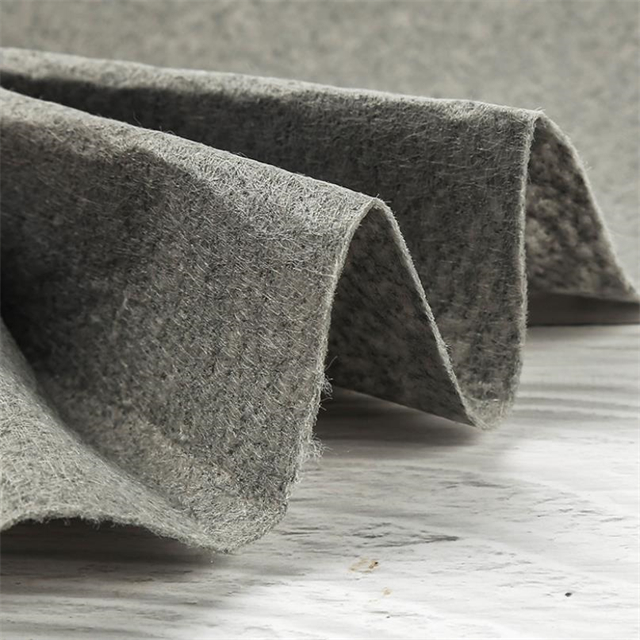
The method used to bind the fibers together is just as important as the density itself. The structural binding influences the effectiveness of the chosen density, determining how well the material maintains its engineered properties under stress.
The thermal bonding process uses specialized low-melt fibers blended into the primary polyester matrix. When the material passes through an industrial oven, these low-melt fibers activate, fusing the matrix together at thousands of microscopic intersection points without the use of chemical adhesives. This process enhances the structural integrity of specific density profiles.
Thermal Bonded Padding maintains structural memory under repeated compression cycles far better than loose fiberfill. The fused nodes act like tiny springs, preventing individual fibers from shifting, migrating, or clumping under load. This locked-in structure ensures that the engineered density remains consistent throughout the lifespan of the product.
Understanding the differences between manufacturing techniques is essential for proper specification.
Resin-Bonded: Uses liquid chemical glues sprayed onto the fiber web and cured in an oven. While it can create stiff, high-density boards, the resins can break down over time, become brittle, and release volatile organic compounds (VOCs).
Needle-Punched: Mechanically interlocks fibers using thousands of barbed needles. This creates extremely dense, durable fabrics (like automotive carpeting) but generally lacks the loft and cushioning required for upholstery or deep filtration.
Thermal Bonded: Yields superior recovery and lower VOC emissions compared to resin-bonded alternatives. Because it relies entirely on polymer fusion, it aligns perfectly with green building certifications and strict indoor air quality standards.
Selecting the right material requires a decision framework that balances performance requirements with commercial realities. There is no universal solution; every specification involves trade-offs between durability, weight, and material consumption.
Pros: Exceptional resistance to wear, structural firmness, longevity, superior water shedding in outdoor environments, and high dimensional stability.
Cons: Increased weight, higher raw material consumption, reduced pliability, and harder to cut or shape on the assembly line.
Best Use Cases: Commercial seating, marine cushions, heavy-duty filtration media, industrial insulation, and structural acoustic panels.
Pros: High loft, lightweight, excellent acoustic absorption for high frequencies, highly pliable, and easy to manipulate during manufacturing.
Cons: Rapid volume loss under sustained pressure, inadequate for prolonged seating or load-bearing applications, and susceptible to fiber migration if not properly bonded.
Best Use Cases: Decorative upholstery wrap, acoustic wall panels, lightweight apparel insulation, and temporary protective packaging.
Performance Vector | High-Density Polyester | Low-Density Polyester | Standard Polyurethane Foam |
|---|---|---|---|
Compression Lifespan | Excellent (Maintains IFD) | Poor (Prone to flattening) | Good (Subject to oxidation) |
Airflow & Breathability | High | Very High | Low (Traps heat) |
Moisture Retention | Low (Rapid drainage) | Low (Dries quickly) | High (Acts like a sponge) |
Structural Memory | High (With thermal bonding) | Low | Moderate (Degrades over time) |
Analyzing the cost-to-lifespan ratio is critical for procurement teams. Over-specifying density wastes budget on unnecessary material volume and increases shipping weights. However, under-specifying density is far more damaging. It leads directly to product failure in the field, triggering customer complaints, warranty replacements, and severe brand damage.
Selecting the precise density optimizes both performance and commercial viability. Engineers must work closely with suppliers to dial in the exact GSM and thickness required to pass lifecycle testing without adding excessive safety margins that inflate production costs.
Transitioning from theoretical specifications to full-scale production introduces practical challenges. Integrating specified polyester padding into existing production lines requires careful planning and quality control oversight.
We must acknowledge the inherent limitations of polyester fiber compared to ultra-high-density foam regarding prolonged, heavy structural support. While high-density polyester is excellent, extreme point-loading can eventually cause fatigue.
Effective mitigation tactics involve composite construction. For example, layering high-density thermal bonded padding over a firm, high-density foam core or a spring unit balances comfort, budget, and structural longevity. The polyester provides the breathable, moisture-resistant contact layer, while the core handles the extreme load-bearing duties.
Visual inspections are inadequate. Necessary testing protocols include ASTM D3574, ASTM D1564, or equivalent ISO standards to verify density, IFD, and compression set before mass production begins.
Conduct initial IFD testing on raw samples to establish a baseline.
Perform dynamic fatigue testing (e.g., roller shear or constant force pounding) to simulate years of use.
Measure the final height and IFD loss to determine the compression set.
Audit vendor facilities regularly to ensure density variance remains within acceptable tolerances across different production batches.
Material density remains the single most critical variable in predicting the lifecycle, comfort, and performance of polyester padding. Relying on visual loft or generic specifications guarantees inconsistent product quality and premature failure in the field. Prioritize high-density, thermal bonded padding for durability, outdoor weatherability, and load-bearing applications. Opt for low-density profiles only for acoustic panels, lightweight insulation, and non-structural wraps where compression resistance is not a factor.
Request comprehensive technical data sheets (TDS) from suppliers detailing GSM, thickness, and IFD equivalents.
Mandate strict compression recovery and fatigue tests based on standardized ASTM or ISO protocols.
Order physical samples and conduct in-house lifecycle testing before finalizing any material specifications.
Establish clear tolerance limits for density variance and audit vendor manufacturing processes to ensure compliance.
A: Density refers to the mass of the material per unit volume, indicating how tightly packed the fibers are. Firmness measures the material's resistance to compression or yielding under weight. While higher density often leads to greater firmness, the manufacturing method and fiber denier also heavily influence the final feel and support.
A: Thermal bonding melts specialized low-temperature fibers within the matrix to fuse the entire structure together at microscopic intersection points. This prevents the primary fibers from migrating, shifting, or clumping under pressure. The fused network maintains its shape and structural memory significantly longer than loose or resin-bonded alternatives.
A: Yes, high-density polyester can replace foam, especially in environments where moisture resistance, breathability, and low VOC emissions are critical. For extreme load-bearing applications, engineers frequently use a hybrid approach, layering high-density polyester over a firm core to maximize both surface comfort and deep structural durability.
A: If the density is too low, the material lacks the necessary structural integrity to support weight. It will compress quickly and permanently under load, leading to a phenomenon known as "bottoming out." This results in poor user comfort, rapid product degradation, and a sharp increase in warranty claims.
A: Polyester density is typically measured in grams per square meter (GSM) or ounces per square yard, combined with a thickness measurement. Foam density is usually measured in pounds per cubic foot (PCF). To accurately compare performance and support, engineers look at Indentation Force Deflection (IFD) ratings for both materials.
A: No. Denier measures the thickness of an individual fiber, while density measures how tightly those fibers are packed into a given volume. You can have thick fibers (high denier) packed loosely (low density), or very thin fibers (low denier) packed tightly together (high density).


