
Views: 0 Author: Site Editor Publish Time: 2026-08-06 Origin: Site


The structural integrity, insulative capacity, and lifespan of textile and industrial products rely entirely on the specification of correct non-woven substrates. Procurement and engineering teams frequently misalign material specifications, confusing dense, mechanically interlocked fabrics with high-loft bonded wadding. This leads to product failure, improper drape, structural collapse, or compromised thermal performance on the production floor.
To mitigate manufacturing risks and optimize product performance, this guide provides a technical evaluation of these two Basic Materials. We will compare their manufacturing processes, structural capabilities, and ideal use cases. Understanding the exact mechanical and thermal properties of these substrates prevents costly rework and ensures your final assembly meets all load-bearing and insulation requirements.
Mechanical vs. Chemical/Thermal Bonding: Needle punched felt relies on barbed needles to mechanically interlock fibers, creating a dense, flat, and highly durable structure. Polyester wadding typically utilizes thermal or resin bonding to trap air and maximize loft.
Performance Trade-Offs: Needle punched materials prioritize tensile strength and structural rigidity, whereas polyester wadding prioritizes thermal insulation, acoustic dampening, and softness.
Material and Fiber Dynamics: While polyester is the dominant synthetic polymer for both formats, natural alternatives (like wool and cotton) alter the weight, friction, and moisture handling of the finished substrate.
Application Specificity: Selecting between these basic materials requires mapping project requirements against specific evaluation dimensions: drape, density, washability, and fiber migration risks.
Risk Mitigation: Incorrect material specification leads to "bearding" (fiber migration), unintended shrinkage, or loss of structural integrity under stress.
Establishing whether the primary function of the material is structural support, thermal insulation, acoustic dampening, or filtration forms the foundation of substrate selection. Engineers must define the end-use environment before evaluating any non-woven product. A material designed to trap heat in extreme weather apparel will fail if deployed as a rigid backing in automotive upholstery. You have to look at the physical demands of the application space.
Calculating the required thickness, or loft, versus the required weight and firmness, or density, ensures the product meets exact specifications. High loft materials occupy more volume with less mass, trapping air effectively. High density materials pack more mass into a smaller volume, offering structural resistance. You must map these parameters directly to the physical demands of the final product. We use specific metrics like grams per square meter (GSM) and compression recovery percentages to lock in these requirements.
Determining how the material must behave when manipulated, folded, or integrated into complex geometries dictates the required drape and flexibility. Stiff materials hold shapes and creases but resist bending. Soft, pliable materials conform to complex curves but offer zero load-bearing capacity. When you run these materials through automated cutting tables, their drape characteristics dictate feed rates and tension settings.
Deciphering industry jargon remains a significant hurdle. Terms like "batting," "wadding," and "felt" often overlap in retail contexts but carry strict technical definitions in industrial procurement. Needle-punched battings functionally behave as semi-rigid felt-like structures, whereas bonded wadding implies a lofty, air-filled matrix. Recognizing these distinctions prevents costly specification errors.
Define the primary thermal or structural load the material will face in the field.
Calculate the maximum allowable thickness to fit within the product assembly tolerances.
Determine the required GSM to meet weight restrictions.
Assess the necessary flexibility for automated handling and sewing operations.
The mechanical felting process defines the structural nature of this substrate. Thousands of barbed needles repeatedly penetrate a loose fiber web, catching individual strands and dragging them through the matrix. This action mechanically entangles the fibers without the use of chemical binders or heat. The result is a highly consolidated, unified fabric capable of withstanding significant physical stress. The needle loom operates at high speeds, and the density of the final product depends directly on the needle punch density and the feed rate of the fiber web.
Evaluating the performance differences between fiber variations reveals distinct operational advantages. A 100% synthetic Needle Punched Felt offers excellent resistance to moisture, mold, and chemical degradation. Wool felt provides natural flame resistance and moisture wicking. Blended options allow manufacturers to dial in specific characteristics, balancing cost with required performance metrics. We often see blends used to hit specific acoustic dampening targets in automotive applications.
The performance characteristics of mechanically interlocked felts include:
High density and low loft, creating a thinner and flatter profile.
Superior tensile strength and high resistance to tearing or puncturing.
A firm texture that holds creases and maintains structural shape under load.
Excellent dimensional stability when subjected to lateral tension.
Predictable thickness tolerances across large production runs.
These attributes make the material ideal for filtration systems, automotive acoustics, structural backing in upholstery, dense quilting, and heavy-duty crafts. Whenever a project demands dimensional stability over thermal retention, mechanically entangled felts provide the necessary performance. You will find this material acting as the hidden backbone in many composite assemblies.
Fiber Type | Primary Advantage | Common Industrial Application |
|---|---|---|
100% Polyester | Moisture and mold resistance, high durability | Automotive backing, outdoor filtration |
100% Wool | Natural flame resistance, thermal regulation | High-end acoustic panels, specialized apparel |
Poly-Wool Blend | Cost-effective balance of durability and acoustics | Furniture upholstery, industrial padding |
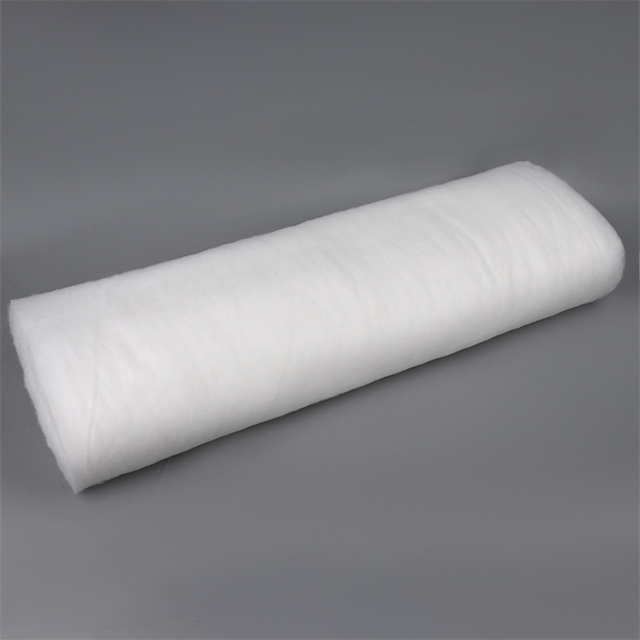
Polyester wadding is typically manufactured using thermal bonding or resin bonding to adhere fibers together while maintaining maximum open space. In thermal bonding, low-melt fibers are blended into the web and passed through an oven; as they melt, they fuse the surrounding fibers at contact points. Resin bonding applies a liquid adhesive to the web before curing. Both methods secure the fiber matrix without crushing the trapped air pockets. The oven temperatures and dwell times are strictly controlled to prevent over-melting, which would destroy the loft.
Comparing cotton versus polyester batting regarding loft retention, weight, moisture absorption, and compressibility highlights the dominance of synthetic options in high-volume applications. Polyester retains its loft after compression, resists moisture absorption, and weighs significantly less than an equivalent volume of cotton. Cotton offers a flatter, heavier drape and absorbs moisture, which can be advantageous in specific textile applications but detrimental in outdoor or high-humidity environments. We specify polyester when weight reduction is a primary engineering goal.
The performance characteristics of bonded wadding include:
High loft and volume paired with a lower overall weight.
Excellent thermal insulation achieved through trapped air pockets.
A soft, flexible drape with notably lower structural rigidity compared to felt.
High compressibility for packaging and transport.
Rapid recovery of original volume after unpacking.
Primary applications include apparel insulation, high-loft quilting, upholstery padding, and acoustic dampening panels where volume is required without adding mass. It is the definitive choice for applications requiring a soft, voluminous hand-feel. When you need to fill a void space efficiently without adding structural weight, bonded wadding is the standard solution.
The mechanical interlocking of needle punched felt inherently sacrifices loft to achieve density. The needles compress the web, driving out air to maximize fiber-to-fiber friction. Conversely, the bonding processes used for polyester wadding sacrifice density to maintain loft, relying on localized fusion points rather than mass entanglement. You cannot have maximum loft and maximum density in the same single-layer substrate.
Tactile rigidity and softness nuances vary significantly based on the exact manufacturing method. Resin-bonded polyester wadding can sometimes feel firmer and hold creases better than unbonded or lightly thermally bonded variants. Conversely, unbonded needle punched felt can maintain a surprisingly soft, flexible drape compared to highly compressed, chemical-bonded felts used in heavy industry. The specific denier of the fibers used also plays a massive role in the final hand-feel.
Scalability in manufacturing heavily influences material selection. Needle punched felt resists fraying and cuts cleanly under automated die-cutting or laser systems, making it highly efficient for rapid processing. High-loft wadding may require compression during cutting or specialized rotary tools to prevent the material from shifting or snagging during automated assembly. If your cutting room is not equipped to handle high-loft materials, you will face severe bottlenecking.
Evaluation Dimension | Needle Punched Felt | Polyester Wadding |
|---|---|---|
Density vs. Loft | High density, low loft. | Low density, high loft. |
Tactile Rigidity | Firm, holds shapes well. | Soft, highly compressible. |
Manufacturing Scalability | Cuts cleanly, no fraying. | Requires care to avoid snagging. |
Long-Term Degradation | Highly resistant to mechanical stress. | May lose loft over time if compressed. |
Thermal Insulation | Poor to moderate. | Excellent due to trapped air. |
Assessing washability and resistance to mold or mildew is critical for long-term performance. Synthetic polyester inherently resists biological degradation. However, you must evaluate how each material withstands repeated mechanical stress or laundering. Dense felts maintain their structure through aggressive washing, while high-loft waddings may clump or lose volume if not properly quilted or stabilized within the final product.
Analyzing the manufacturing costs reveals distinct economic profiles. Needle punched felt requires machine-intensive processing, utilizing massive needle looms that consume significant energy and require frequent maintenance. Bonded polyester wadding often utilizes faster, continuous-oven processes. This impacts bulk procurement strategies, requiring buyers to balance upfront material costs against long-term performance requirements. You have to factor in the yield per roll and the scrap rates during cutting.
The inherent trade-off exists between a material that provides excellent structural support and one that provides superior comfort and flexibility. You cannot achieve maximum loft and maximum tensile strength in a single homogeneous layer. Engineering teams must prioritize the primary function of the component. If the component must bear weight, you sacrifice loft. If it must insulate, you sacrifice rigidity.
To bypass these limitations, manufacturers frequently employ hybrid and layered approaches. Using a layered system—utilizing a dense needle punched base for structure, topped with a high-loft polyester wadding for surface softness—delivers composite performance. A core-and-shell integration utilizes a highly economical polyester wadding core covered with a needle-punched wool or felt exterior layer to achieve excellent dimensional shape definition, volume, and color finishes. We see this composite approach extensively in high-end furniture manufacturing.
High-loft wadding is prone to "bearding," where individual fibers migrate through the outer shell fabric, ruining the visual appearance of the product. This happens when the outer fabric has a loose weave or when the wadding fibers are too fine. To mitigate this risk, specify wadding with a protective scrim layer or utilize needle punched felt where surface penetration is a strict failure point.
Incorrectly specified materials may warp, stretch, or shrink during post-processing or end-user washing. Structural deformation compromises the entire product assembly. Mandate strict pre-washing protocols or specify thermally set needle punched polyester felt to guarantee dimensional stability under thermal or mechanical stress. Thermal setting locks the fibers in place, preventing future shrinkage.
Compression during shipping or extended warehouse storage can permanently alter the loft of polyester wadding. If the fibers suffer from compression set, the material will not recover its intended volume, destroying its insulative properties. Implement strict storage guidelines, avoid double-stacking pallets, and enforce recovery-time protocols prior to manufacturing integration.
Specify scrim-backed wadding for applications prone to fiber migration.
Require thermal setting for any felt used in high-temperature environments.
Enforce a 24-hour unrolled recovery period for vacuum-packed wadding before cutting.
Conduct wash-testing on all composite assemblies to verify dimensional stability.
Needle punched felt provides the density, tensile strength, and structural rigidity required for demanding industrial applications. Polyester wadding delivers the high loft, thermal insulation, and soft drape necessary for apparel and comfort-focused products. Base your final procurement decisions on a strict matrix of loft requirements, structural load, and thermal performance criteria.
Request detailed Material Data Sheets (MDS) from suppliers to verify density and bonding methods.
Acquire physical samples of both materials to assess drape, hand-feel, and cutting behavior on your specific equipment.
Conduct prototype stress-testing under simulated end-use conditions to evaluate fiber migration and structural integrity.
Implement strict storage protocols for high-loft materials to prevent permanent compression set in your warehouse.
A: Functionally, yes. Needle punched batting is mechanically entangled using barbed needles, creating a dense, flat structure identical to traditional felt. While retail terminology varies, the industrial manufacturing process and resulting physical properties are the same.
A: No. Polyester wadding lacks the tensile strength and density required for structural support. It will compress, shift, and fail under mechanical load. Felt must be used when rigidity and shape retention are required.
A: Mechanically interlocked felt has very low loft because the needles compress the fibers tightly together. Bonded wadding has high loft because the fibers are fused at contact points, leaving large pockets of trapped air between them.
A: The repeated penetration of barbed needles heavily entangles the fibers, creating massive internal friction. This mechanical interlocking significantly increases the tensile strength and tear resistance of the resulting fabric compared to loose or lightly bonded webs.
A: Synthetic polyester fibers inherently resist shrinking and degradation. If the felt has been thermally set during manufacturing, it will maintain excellent dimensional stability and withstand repeated washing without warping or losing its structural integrity.
A: Bearding occurs when loose fibers migrate through the outer fabric. Prevent this by specifying wadding manufactured with a protective scrim layer, using a tighter weave for the outer shell fabric, or switching to a denser, needle-punched alternative.


