
Views: 0 Author: Site Editor Publish Time: 2026-06-25 Origin: Site


Industrial facilities face constant challenges when managing fluid leaks and accidental spills. Selecting the wrong spill control materials leads to severe compliance violations. It also causes prolonged operational downtime. You cannot afford to rely on guesswork when worker safety and environmental regulations are on the line. Facility managers need a reliable way to manage these hazards quickly.
This guide provides facility managers and procurement teams with an evidence-based framework. We designed this framework to help you evaluate and select the correct absorbent materials. You will learn how to assess products based on fluid type, facility environment, and physical performance metrics. We break down the complex technical differences between various product categories. Read on to discover actionable steps for outfitting your facility with the exact spill protection it requires.
Fluid compatibility is paramount: Never use universal pads for targeted water-surface oil spills, and reserve hazmat pads strictly for aggressive chemicals.
Material construction dictates durability: Meltblown polypropylene remains the industry standard, but bonding techniques (dimpling, spunbond layers) determine if a pad will survive foot traffic or equipment wiping.
Weight equals capacity: Pad weight (light vs. heavy) should align with the specific application (daily drip maintenance vs. emergency spill response).
Total cost of ownership extends beyond the purchase price: Saturated weight and local disposal regulations often cost more than the pads themselves.
Every facility presents a unique set of operational hazards. You must map out your specific risks before purchasing any spill response supplies. Identify whether your operations deal primarily with chronic leaks or acute spill risks. Chronic leaks include constant machinery drips or weeping valves. Acute risks involve sudden bulk transfer spills or catastrophic equipment failures. Mapping these hazards dictates the volume and type of materials you need on hand.
Next, you must establish clear success criteria for your spill response plan. Define exactly what a successful deployment looks like in your facility. Consider the following common benchmarks:
Zero visible oil reaching municipal drains or local waterways.
Strict compliance with local and federal environmental regulations.
A measurable reduction in workplace slip-and-fall incidents.
Faster cleanup times during routine maintenance schedules.
Avoid "one-size-fits-all" thinking during your planning phase. Many buyers make the mistake of ordering a single product type for every department. Acknowledge the implementation reality of industrial sites. Most plants require a mix of highly specialized products. A heavy equipment bay needs different protection than a delicate chemical laboratory. Tailoring your approach ensures better safety and improved operational efficiency.
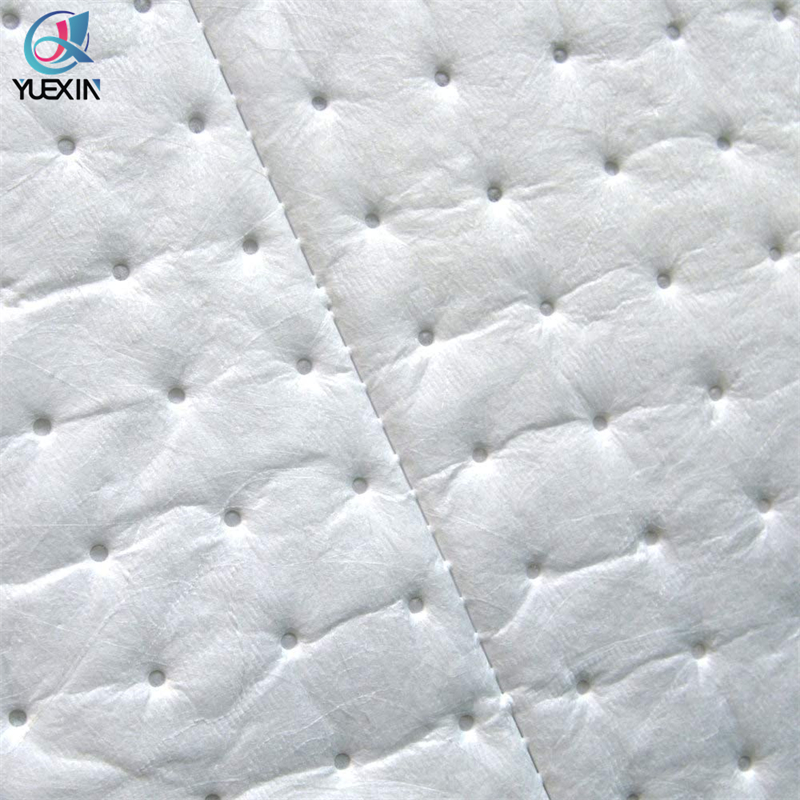
Choosing the correct fluid compatibility is the most critical step in spill control. The industry uses a universal color-coding system to identify pad types quickly. Understanding these distinctions prevents dangerous chemical reactions and ensures efficient cleanup.
White pads are exclusively designed for hydrocarbon spills. They utilize a hydrophobic and oleophilic mechanism. This means they repel water entirely while rapidly absorbing oil, diesel, gasoline, and lubricants. You can leave them in the rain, and they will only absorb the target hydrocarbons.
Their ideal use case includes marine environments and outdoor retention ponds. They are incredibly useful for separating floating oil from water-based coolants inside CNC machines. When you need targeted Oil Absorbent Pads, always look for the brilliant white color.
Gray pads serve as the versatile workhorse of the manufacturing world. They feature a hydrophilic mechanism, meaning they absorb all liquids indiscriminately. They easily soak up water, chemical coolants, industrial solvents, and machine oils.
These pads belong on indoor manufacturing floors. They excel in general maintenance applications and under leaky pipes. Gray pads are perfect for environments where multiple liquid types mix on the floor. However, never deploy them outdoors on water surfaces. They will simply absorb the water and sink.
Yellow pads provide a high-visibility warning for dangerous situations. Their primary mechanism relies on being chemically inert. They will not degrade, melt, or react when exposed to aggressive acids or caustic bases. They handle unknown toxic fluids safely.
Chemical storage areas and laboratories must stock yellow hazmat products. They are also mandatory for hazardous material transport vehicles. The bright yellow color alerts cleanup crews to handle the saturated materials with extreme caution.
Pad Type | Color Code | Absorption Mechanism | Best Use Environment |
|---|---|---|---|
Oil-Only | White | Hydrophobic (Repels Water) | Outdoors, Marine, CNC Tanks |
Universal | Gray | Hydrophilic (Absorbs All) | Indoor Floors, Mixed Liquids |
Hazmat | Yellow | Chemically Inert | Laboratories, Acid Storage |
Not all Industrial Oil Absorbent Pads are manufactured equally. Understanding the underlying science helps you select a product durable enough for your facility. The manufacturing process dictates how well the product withstands physical abuse.
Modern spill control relies heavily on meltblown polypropylene. This synthetic polymer undergoes a unique extrusion process. Manufacturers melt the plastic and blow it through tiny nozzles at high velocity. This creates a random web of incredibly fine microfibers.
This high-surface-area microfiber structure generates powerful capillary action. The microscopic voids physically draw liquids in quickly. Once inside, the fibers lock the liquid away. This retention capability prevents messy dripping during the transport of saturated materials.
While the internal microfibers do the heavy lifting, the external bonding determines durability. You must match the bonding style to your facility's physical demands.
Single-ply (Unbonded): These feature a loose fiber structure. They offer extremely fast absorption and remain highly flexible. However, they are highly prone to linting and tearing. They work best for gentle, single-use spill cleanup where abrasion is minimal.
Dimpled/Sonic Bonded: Manufacturers use ultrasonic rollers to weld the fibers together at specific points. This creates a dimpled texture. Point-bonding provides vital structural integrity. The pad holds together firmly even when fully saturated.
Fine-Fiber/Spunbond (Multi-layer): These represent the premium tier of spill control. They feature a highly durable, woven-like outer layer. This construction is essential for high-abrasion areas. You can use them for wiping sharp tools or enduring heavy foot traffic without shedding fibers.
Selecting the correct material weight ensures you have enough capacity without wasting resources. Manufacturers typically offer products in varying thicknesses to accommodate different scenarios.
Lightweight products are highly cost-effective for daily maintenance. Use them to catch small, continuous nuisance drips around the plant. Their thinner profile makes them exceptionally easy to mold around complex machinery bases. They fit snugly into tight crevices where bulkier materials fail.
Medium and heavyweight options are engineered for crisis management. They are designed for maximum volume retention in emergency spill scenarios. A heavyweight product quickly absorbs a large puddle before it spreads into walkways. You need these stationed near bulk fluid transfer areas.
When assessing capacity, look closely at the absorption ratio. Many brands advertise that a product "absorbs 20x its weight." We advise buyers to practice healthy skepticism regarding maximum capacity marketing claims. Always test the real-world retention yourself. Lift a saturated sample and observe it closely. Does it drip uncontrollably when lifted? True performance relies on liquid retention, not just initial absorption.
Weight Category | Thickness Profile | Primary Application | Volume Capacity Focus |
|---|---|---|---|
Lightweight | Thin & Flexible | Daily nuisance drips, wiping parts | Low volume, continuous capture |
Medium-weight | Standard thickness | General floor spills, under pipes | Moderate volume retention |
Heavyweight | Thick & Dense | Emergency bulk spills, deep puddles | Maximum volume extraction |
Facility managers carry the heavy burden of ensuring regulatory compliance. Proper deployment of spill control supplies directly supports major federal mandates. It is not just about keeping the floor clean; it is about protecting the enterprise from severe penalties.
The EPA mandates strict Spill Prevention, Control, and Countermeasure (SPCC) plans for many facilities. Deploying the right hydrophobic materials around outdoor oil storage prevents unauthorized environmental discharge. Simultaneously, OSHA enforces strict Walking-Working Surfaces mandates. Keeping aisles free of slick oil residues protects workers and fulfills OSHA requirements.
You must also navigate misleading industry marketing. Many suppliers make exaggerated claims regarding "infinite reusability." In a heavy industrial setting, physical degradation happens rapidly. Materials tear, and microscopic debris clogs the polymer fibers. True infinite reuse is a persistent industry myth.
Furthermore, remain vigilant against "100% eco-friendly" promises. Some manufacturers promote biodegradable spill supplies. However, the fluid dictates the hazard level, not the cleanup medium. Once a biodegradable product absorbs hazardous hydraulic fluid, it immediately becomes hazardous waste. You cannot simply throw it into a standard compost bin. Understanding these realities keeps your facility compliant and safe.
Choosing the correct spill control supplies protects your workforce and your environment. You can navigate the purchasing process confidently by applying a structured shortlisting logic. Follow these sequential steps for optimal results:
Identify the liquid: Match the fluid hazard to the correct color-coded category.
Assess durability needs: Determine if you need sonic-bonded or spunbond layers for foot traffic.
Choose weight based on volume: Select lightweight for drips and heavyweight for emergencies.
Your immediate next step requires real-world validation. Encourage your procurement team to request sample packs from suppliers. Test the retention capabilities and linting resistance in your specific facility conditions. Conducting a physical trial prevents costly mistakes before you commit to ordering bulk pallets.
A: A standard 15" x 19" heavyweight pad typically holds between 28 to 35 ounces of liquid. Lightweight versions generally hold half that amount. However, liquid viscosity greatly affects real-world capacity. Thick gear oils cling heavily to the surface, while thin solvents penetrate the fibers faster.
A: Yes, some high-quality unbonded or dimpled versions can be wrung out or centrifuged. However, their structural integrity degrades very quickly after mechanical wringing. In most heavy industrial applications, the internal labor costs to extract the fluids often outweigh the minor savings of reusing the materials.
A: You must dispose of them based entirely on the fluid they absorbed, not the pad material itself. If the product absorbed a hazardous chemical or regulated oil, you must follow local, state, and federal hazardous waste guidelines. Never throw hazardous waste into standard municipal trash receptacles.
A: The difference lies primarily in their form factor and application. Pads are flat sheets designed for surface coverage, catching drips, and wiping machinery. Booms are long, cylindrical tubes designed for containment. Booms create a floating barrier on waterborne spills to prevent oil from spreading outward.


